The Quest for an Ideal Youth in Putin's Russia I: Back to Our Future! History, Modernity, and Patriotism According to Nashi, 2005-2013 by Ivo Mijnssen
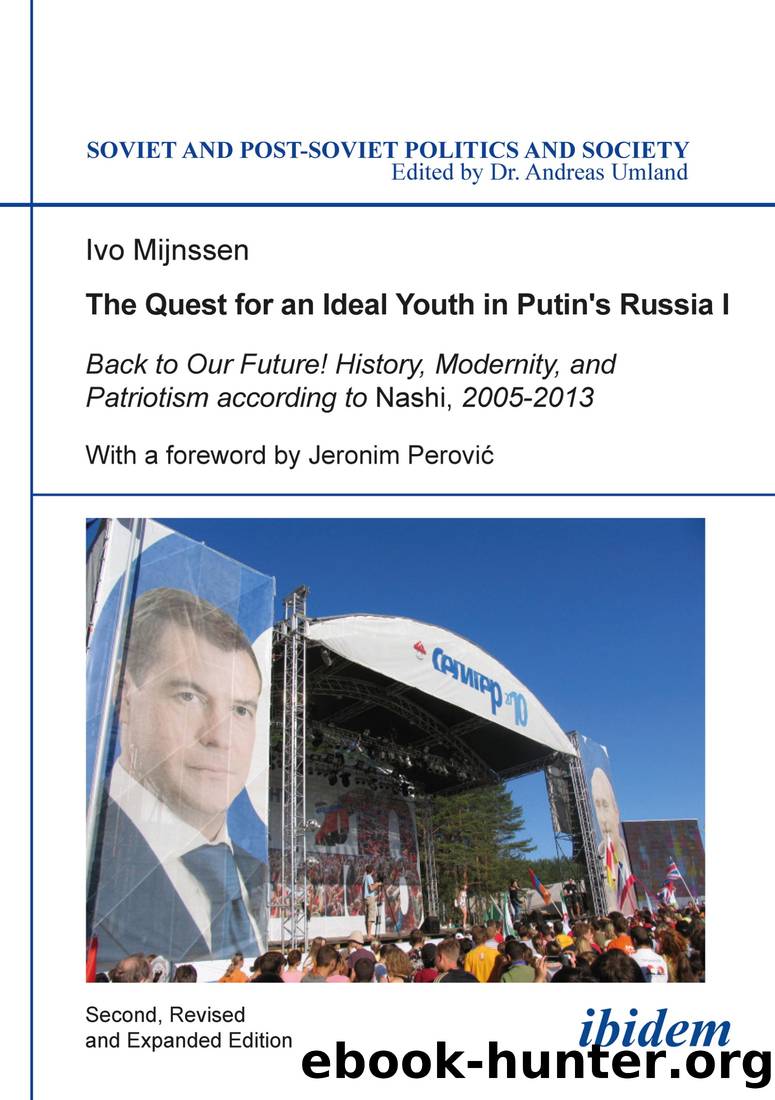
Author:Ivo Mijnssen [Mijnssen, Ivo]
Language: eng
Format: epub
Tags: Russia & the Former Soviet Union, Modern, Civics & Citizenship, Political Science, History, 21st Century
ISBN: 9783838205786
Google: wfOWjgEACAAJ
Goodreads: 28635988
Publisher: Ibidem Press
Published: 2014-01-15T13:06:18+00:00
The conflict with Estonia reveals the problems inherent in using the historical template of the war as a hegemonic discourse to describe political problems of the present. Nashiâs antagonization of «fascist» Estonia stands in clear contradiction to an agonistic view of Europe. Russiaâs official discourse frames Europe as a partner for Russia and Russia as a European nation. The latter notion is also central to Sovereign Democracy. Surkov calls Russia a «European country» and believes that it should aim for the same civilizational goals that European countries have pursued throughout the modern period: cooperation, material well-being and popular participation in decision making (Surkov 2006a: 44ff.). As we have seen in chapter 2, Nashi shares these goals.
The official war narrative that Nashi defended so vehemently during the conflict with Estonia is also closely tied to a defense of European civilization in Russiaâs official discourse.
«The heroic narrative of the Great Patriotic War links Russia with Europe and/or civilization, because it can be told in such a manner that the Soviet Union will appear at the centre of the struggle for genuine European values against a barbarian force (stemming, by the way, from the very heart of Europe).» (Morozov 2008: 159)
Nashi articulated this notion of defending «European values» during the conflict with Estonia. The question is, however, how Estonia could simultaneously signify both «fascism» and «Europe» in Nashiâs discourse.
Viacheslav Morozov suggests an interesting resolution for this apparent discursive paradox: the distinction between «real» and «false» Europe. According to this differentiation, the «real» Europe, which stands for humanist and enlightenment values with which Russia identifies itself is different from the «false» Europe â a Europe under American influence (Morozov 2004: 320). In this narrative, an (American) antagonist is using a «false» Europe for the purpose of weakening Russia and thereby keeping it distant from its «natural» partners in Europe.
During the conflict with Estonia, Nashi articulated this distinction in various ways. One such way was the appeal to the European Union to exercise its influence on Estonia and defend «European values». Another was Nashiâs verbal attack on NATO and the US. Ironically, Russian attacks against Estonia during the conflict only promoted a stronger role by NATO in Estonia and led to the establishment of the NATOâs Cooperative Cyber Defence Centre of Excellence in the country, which has become a strategic priority for the alliance since.
Download
This site does not store any files on its server. We only index and link to content provided by other sites. Please contact the content providers to delete copyright contents if any and email us, we'll remove relevant links or contents immediately.
The Vikings: Conquering England, France, and Ireland by Wernick Robert(84445)
Ali Pasha, Lion of Ioannina by Eugenia Russell & Eugenia Russell(40340)
The Conquerors (The Winning of America Series Book 3) by Eckert Allan W(38183)
The Vikings: Discoverers of a New World by Wernick Robert(37027)
Cecilia; Or, Memoirs of an Heiress — Volume 1 by Fanny Burney(32665)
Cecilia; Or, Memoirs of an Heiress — Volume 2 by Fanny Burney(32030)
Cecilia; Or, Memoirs of an Heiress — Volume 3 by Fanny Burney(32013)
Empire of the Sikhs by Patwant Singh(23158)
The Secret History by Donna Tartt(19375)
Hans Sturm: A Soldier's Odyssey on the Eastern Front by Gordon Williamson(18681)
Cat's cradle by Kurt Vonnegut(15480)
Pimp by Iceberg Slim(14720)
Sapiens: A Brief History of Humankind by Yuval Noah Harari(14492)
Norse Mythology by Gaiman Neil(13490)
Talking to Strangers by Malcolm Gladwell(13480)
Leonardo da Vinci by Walter Isaacson(13434)
4 3 2 1: A Novel by Paul Auster(12554)
Underground: A Human History of the Worlds Beneath Our Feet by Will Hunt(12180)
The Radium Girls by Kate Moore(12125)
